


News
News
Zhejiang Development and Reform Commission Releases the 13th Five-Year Plan for Solar Energy Development
Release time:
2016-11-23
This is a crucial period for the province to become a national-level clean energy demonstration province, and it is also an important stage for the large-scale and comprehensive promotion of renewable energy sources such as photovoltaic power generation. In order to guide the rapid, healthy, and orderly development of solar energy, especially photovoltaic power generation in our province during the 13th Five-Year Plan period, this document is compiled based on the "13th Five-Year Plan for Energy Development in Zhejiang Province", the "Implementation Plan for Zhejiang Province to Create a Clean Energy Demonstration Province", the national "Several Opinions on Promoting the Healthy Development of the Photovoltaic Industry", the "Energy Development Strategic Action Plan (2014-2020)", and the "Notice from the National Energy Administration on Doing a Good Job in Compiling the 13th Five-Year Plan for Solar Energy", etc.
The 13th Five-Year Plan is a crucial period for Zhejiang Province to comprehensively promote the revolution in energy production and consumption, and to accelerate the construction
of a national-level clean energy demonstration province. It is also an important stage for the large-scale and comprehensive promotion of renewable energy sources such as photovoltaic power generation. To guide the rapid, healthy, and orderly development of solar energy, especially photovoltaic power generation, during the 13th Five-Year Plan period in our province, and in accordance with the "Zhejiang Province Energy Development 13th Five-Year Plan", the "Zhejiang Province Clean Energy Demonstration Province Implementation Plan", the national "Several Opinions on Promoting the Healthy Development of the Photovoltaic Industry", the "Energy Development Strategic Action Plan (2014-2020)", and the "Notice from the National Energy Administration on Doing a Good Job in Compiling the Solar Energy 13th Five-Year Plan", etc., the "Zhejiang Province Solar Energy Development 13th Five-Year Plan" is compiled. This plan is an important basis for guiding the development of photovoltaics in Zhejiang Province during the 13th Five-Year Plan period, with a planning period of 2016-2020.
I. Development Foundation
(A) Solar Energy Resource Conditions
The annual average total solar radiation in Zhejiang Province is between 4220 and 4950 MJ/m², with a provincial average of around 4440 MJ/m², which is at a moderate level nationally. In general, the distribution of solar radiation in Zhejiang Province is not significantly affected by geographical latitude, but is significantly affected by topography. There is a distribution characteristic where plains, basins, and islands have higher radiation, while mountainous areas have lower radiation. See Figure 1 for the map of the annual average solar radiation distribution in Zhejiang Province.
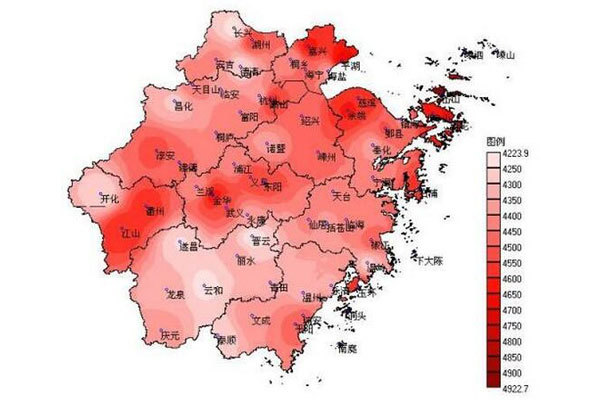
Figure 1 Annual Average Total Solar Radiation Distribution Map of Zhejiang Province (MJ/m²)
(B) Development Achievements
During the 12th Five-Year Plan period, with the strong support of national and provincial policies, the development and application of photovoltaic power generation in Zhejiang Province has achieved rapid progress. Rooftop distributed photovoltaics are leading the nation, with remarkable achievements in installed capacity, application innovation, and industrial drive, and solar thermal utilization is steadily advancing.
1. Year-on-Year Doubling of Installed Capacity
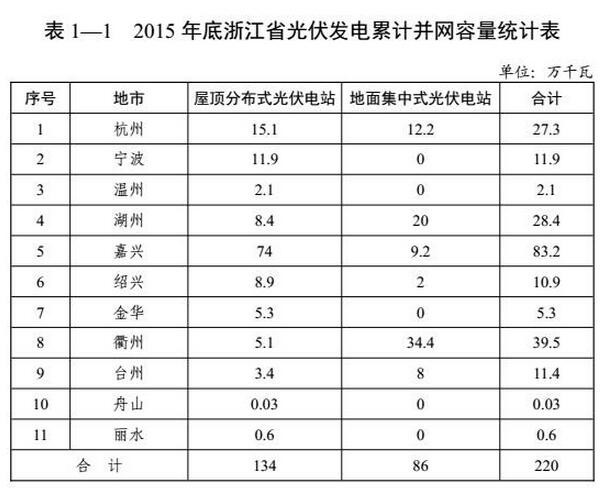
By the end of 2015, the installed capacity of photovoltaic power generation in Zhejiang Province reached 2.2 million kilowatts, a 73-fold increase from less than 30,000 kilowatts at the end of 2010, with an average annual growth rate of 130%. Among them, the total installed capacity of national Golden Sun and photovoltaic building integration demonstration projects is about 410,000 kilowatts, ranking second in the country; the total installed capacity of rooftop distributed photovoltaic power generation is 930,000 kilowatts, ranking first in the country; the total installed capacity of ground-based photovoltaic power plants such as agricultural and photovoltaic complementation and fishery and photovoltaic complementation is 860,000 kilowatts; and 2009 households have grid-connected household rooftop photovoltaic power generation. Photovoltaic power generation applications in the province have fully entered the stage of large-scale development (see Table 1-1 for details).
During the same period, the application of solar energy, mainly solar water heaters, in Zhejiang Province continued to advance steadily, increasing from 9.2 million square meters in 2010 to 14.6 million square meters in 2015, with an average annual growth rate of 59%.
2. Diverse Application Models
Zhejiang Province has gradually formed a development pattern with multiple models, including large-scale distributed photovoltaics on factory rooftops in industrial parks and economic development zones, agricultural and photovoltaic complementation, fishery and photovoltaic complementation ground-based photovoltaic power plants, photovoltaic building integration in new buildings, and household rooftop photovoltaics. A number of influential benchmark projects have been completed, such as the Asian largest single-building rooftop photovoltaic power generation project at Hangzhou East Railway Station in 2012, the large-scale agricultural and photovoltaic complementation ground-based photovoltaic power plant in Jiangshan, Quzhou in 2014, and the domestic technologically mature large-scale industrial factory building photovoltaic building integration rooftop photovoltaic power generation project in Tonglu, Hangzhou in 2015.
3. Successful Creation of Demonstration Parks
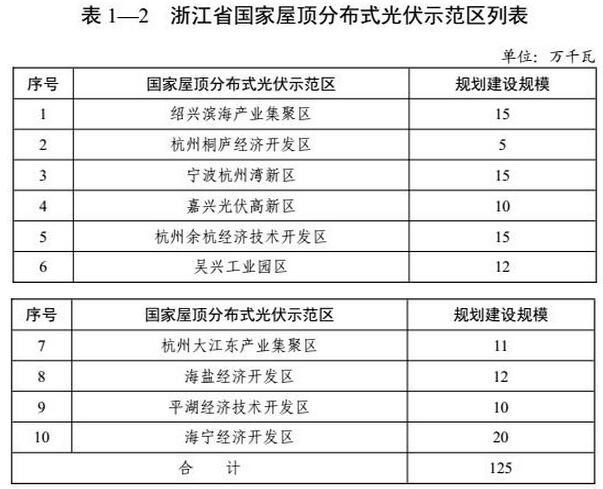
Zhejiang Province actively promotes the construction of demonstration zones for distributed photovoltaic power generation applications. Ten economic and technological development zones and industrial parks, including Jiaxing Photovoltaic High-tech Zone, Haining Economic Development Zone, and Ningbo Hangzhou Bay New Area, have been successfully included in the national demonstration zones for rooftop distributed photovoltaic power generation applications, with a total capacity of 1.25 million kilowatts and a total investment of approximately 10 billion yuan, ranking first in the country. The "five-in-one" rooftop distributed photovoltaic power generation promotion model in Jiaxing Xiuzhou District has become a typical national demonstration of distributed photovoltaic construction.
4. Initial Formation of a Technological Innovation System
Zhejiang Province has initially formed a technological innovation system supporting photovoltaic basic research, industrial development, and market application development. It has national and provincial-level key laboratories and university-industry-research cooperation platforms for the core processes and application technology research and development of the photovoltaic manufacturing industry. It has the R&D capabilities for major core technologies such as processes, applications, energy storage, and equipment. Some photovoltaic products of large photovoltaic manufacturing enterprises in the province have achieved world-leading levels in terms of technology R&D and product quality.
5. Growth of Photovoltaic Enterprises
During the 12th Five-Year Plan period, Zhejiang Province's photovoltaic industry withstood the major adjustments in the international photovoltaic market and the "double anti-dumping" trade actions of European and American countries. It successfully cultivated a group of leading photovoltaic enterprises such as Trina Solar, Jinko Solar, Yuhui, Foster, JA Solar, Global Solar, Zhejiang University Sunny, and Tongjing Technology, which provide "global and integrated services." Photovoltaic enterprises have grown stronger, and the photovoltaic industry has developed healthily. At present, Zhejiang Province has become the second largest production base for photovoltaic products in China. In 2015, the province's photovoltaic component output reached 10.8 GW, accounting for about 26% of the national output, with an annual sales output value of around 130 billion yuan. The photovoltaic industry has become one of the important pillar industries in the province.
6. Consensus Formed Through Vertical and Horizontal Coordination
In accordance with the national photovoltaic industry strategic deployment, governments at all levels in Zhejiang Province attach great importance to and actively promote the application of photovoltaic power generation. Vertical and horizontal coordination at the provincial, municipal, and county levels has resulted in a series of policies on the construction, management, Price, and subsidies of photovoltaic power generation, creating a good development environment for photovoltaic power generation in Zhejiang Province. At the same time, a Zhejiang Provincial Renewable Energy Development Special Fund has been established to accelerate the creation of provincial clean energy demonstration counties and towns, and actively promote the development of photovoltaic power generation and other renewable energy sources in various places. According to preliminary statistics, since 2013, nearly 30 policy documents supporting photovoltaic development have been issued at the provincial, municipal, and county levels.
(C) Existing Problems
1. Development Level Remains Low
Although the rapid development during the 12th Five-Year Plan period has resulted in a certain scale of photovoltaic power generation in Zhejiang Province, its share in the province's power generation capacity and electricity consumption remains small, and there is still enormous room for development. The large number of small rooftop photovoltaic power generation sites and the severe constraints on land and other resources for ground-based photovoltaic power plants have affected the enthusiasm of some places to develop photovoltaic power generation. Long-term consideration of environmental, social, and industrial comprehensive benefits has not been taken into account, and the development of photovoltaic and other clean energy sources has not been elevated to the level of social responsibility.
2. Difficulty in Securing Rooftop Resources
With the continuous development of photovoltaic projects, high-quality roof resources in large and medium-sized industrial parks and economic development zones are increasingly scarce. Some rooftop owners have concerns about safety and leakage, and the expected return on roof leasing is too high, resulting in difficulties in implementing some rooftop projects. The electricity price for public buildings such as schools is relatively low, resulting in low project returns and low enthusiasm for development among investors and rooftop owners. Urban residential buildings have shared ownership of rooftops, and the installation of rooftop photovoltaics requires the consent of all owners, and the benefits belong to all owners of the building, making it difficult to operate in practice.
3. Difficulty in Guaranteeing Corporate Profits
Photovoltaic power generation, especially rooftop distributed photovoltaics, has many uncontrollable factors within the 25-year operating period, making it difficult to guarantee the profits of photovoltaic companies. Changes in homeowners, poor business operations of rooftop companies leading to overdue electricity payments, etc., have increased the investment risks of photovoltaic companies. The rental period of contracts signed between investors in agricultural and fishery photovoltaic complementary projects and landowners is often short, and they may face the risk of rising rental costs. Delays in the issuance of national renewable energy power surcharges also lead to tight cash flow in the initial stage of project construction, affecting project investment returns.
4. Relatively Weak Technological Support
Zhejiang Province's photovoltaic industry's independent innovation capabilities need to be improved, and its high-end manufacturing R&D and system integration capabilities are insufficient, resulting in overcapacity in low- and mid-range products and insufficient high-end capacity. The problem of small, scattered, and low-efficiency photovoltaic enterprises in the province still exists, and few Zhejiang photovoltaic enterprises meet the requirements of the national photovoltaic "leader" certification plan application. Most solar water heater enterprises in Zhejiang Province are small and medium-sized private enterprises, with a single business model, serious product homogeneity, and relatively weak technological R&D capabilities.
5. Asynchronous Policy Support
Land-related policies are unclear. The nature of the land used for pile foundations and battery component arrays that can still guarantee crop growth and fishery production is unclear, and it is also unclear whether land use tax or cultivated land occupation tax should be levied. The construction period of photovoltaic power stations and supporting power grid projects does not match, resulting in difficulties in synchronizing the operation of photovoltaic projects and power grids.
6. Inadequate Management and Services
The standard system is not perfect enough. The standards for the design, construction, acceptance, and evaluation of photovoltaic power stations are not yet perfect, and the inspection mechanism for photovoltaic equipment products still needs to be improved. The quality of equipment, design, construction, and operation and maintenance of power stations is difficult to guarantee, affecting the long-term stable operation of photovoltaic systems. Policy implementation is not in place. The energy consumption double control target responsibility system, which has been introduced in Zhejiang Province, and the restrictive policies requiring high-energy-consuming enterprises to install photovoltaic power generation systems, are difficult to fully implement due to the lack of specific operating rules. There is a lack of effective investment and financing platforms, and the mechanism for connecting banks and enterprises is not perfect, especially the difficulty in financing distributed photovoltaics.
(4) Current Situation
1. The construction of a clean energy demonstration province puts forward new requirements for the development of photovoltaic power generation
In the face of global climate and ecological challenges, the concept of green development is gradually becoming deeply rooted in people's hearts, and vigorously developing clean energy has become an inevitable trend. Photovoltaic power generation, as a clean energy source with mature technology and a high degree of industrialization, has received high attention from countries around the world, and various countries have introduced supporting policies and measures to guide and encourage the rapid and large-scale development of photovoltaic power generation. Currently, China's installed capacity of photovoltaic power generation has reached approximately 43 million kilowatts, ranking first in the world. The preliminary plan is to exceed 150 million kilowatts by 2020. The development space is very broad. Vigorously developing photovoltaic power generation is one of the important measures for Zhejiang Province to build a national clean energy demonstration province. By 2023, the installed capacity of photovoltaic power generation in the province will reach 10 million kilowatts. The goal is clear, and the task is arduous, and the development of the photovoltaic power generation industry in the province faces new challenges.
2. New urbanization and the construction of beautiful countryside bring new opportunities for the development of distributed photovoltaic power generation
With the rapid advancement of the new urbanization process in Zhejiang Province, the intensive, intelligent, green, and low-carbon new urbanization requires the support of large-scale clean energy, providing an opportunity for the construction of distributed photovoltaic power generation on the roofs of industrial parks, public buildings, and industrial and commercial enterprises. According to preliminary statistics, the roof area of buildings in Zhejiang Province with an effective area of over 3000 square meters, mainly industrial parks and public buildings, is approximately 40 million square meters, and more than 5 million kilowatts of distributed photovoltaics can be installed. At the same time, with the construction of beautiful villages in Zhejiang Province, the improvement of the living standards of urban and rural residents, and the deepening of the concept of green energy use, the construction of family rooftop photovoltaics in residential buildings has become a new application space. According to the statistical yearbook, in 2014, there were 16.3 million households registered in Zhejiang Province. If 6% of resident households install family rooftop photovoltaics, the province can develop 1 million family rooftop photovoltaics, with a total scale of about 3 million kilowatts.
3. Modern agriculture and fisheries have created a new concept for the development of photovoltaic power generation
Modern agriculture and fisheries are developing towards scale, intensification, facility-based, and green development. On the one hand, they need photovoltaic power generation to provide energy security, and on the other hand, they have also expanded new space for photovoltaic power generation. Complementary photovoltaic power stations organically combine photovoltaic power generation, modern agricultural planting and fishery farming, and high-efficiency agricultural facilities. Through the three-dimensional utilization of land space in agriculture and fisheries, modern agriculture and fisheries are developed while overcoming the land constraints of photovoltaic power generation, realizing mutual benefit and common development between agriculture and fisheries and photovoltaics. According to preliminary statistics, the scale of agricultural and fishery complementary ground-based photovoltaic power stations using barren hills, barren slopes, facility agricultural land, reclaimed tidal flats, fish ponds, and reservoirs in the province can reach more than 10 million kilowatts.
4. Technological iteration and innovation inject new vitality into the development of photovoltaic power generation
The advancement of "Internet+" and energy storage technologies has brought a breakthrough revolution to the development of photovoltaic power generation, making the entire photovoltaic industry chain more intelligent, efficient, economical, and environmentally friendly. Breakthroughs in core technologies for photovoltaic basic materials, equipment manufacturing, and system applications will greatly improve the photoelectric conversion efficiency, rapidly reduce the cost of photovoltaic power generation, continuously enhance market competitiveness, form sustainable development momentum, gradually transition from an incompletely market-oriented system to a market-oriented one, and achieve a leap from quantity to quality.
II. Overall Requirements
(1) Guiding Ideology
Deeply implement the major decisions and deployments of the sixth meeting of the Central Leading Group for Financial and Economic Affairs, in accordance with the strategic thinking of the "four revolutions and one cooperation" in energy and the five development concepts of "innovation, coordination, green, openness, and sharing", focusing on the construction of a national clean energy demonstration province, taking technological innovation and progress as the core, and taking smart grid construction as the support, accelerating the utilization of solar energy such as rooftop distributed, ground-based centralized, and household photovoltaic, gradually forming a photovoltaic power generation development system with "diversified business models, informatized government management, marketized resource trading, and intelligent operation and management", promoting the healthy development of the photovoltaic industry in the province, continuously improving the utilization level of solar energy, and providing important guarantees for the sustainable development of the economic and social system.
(2) Basic Principles
Unify thinking and increase efforts. Enhance the understanding of the importance of accelerating the application of solar energy by various regions and departments, and place the development of photovoltaic power generation and other renewable energy sources in a prominent position for priority support in local projects. Through actively formulating and issuing local support policies, etc., unify thinking, form synergy, and increase efforts in the development of photovoltaic power generation and other renewable energy sources.
Adapting to local conditions and pursuing differentiated development. Based on different construction sites such as large industrial parks, barren hills and slopes, and rooftops of urban and rural households, we will develop large-scale rooftop photovoltaic power generation, complementary ground-based photovoltaic power stations, and household rooftop photovoltaic systems in a classified and orderly manner. Targeting different regional characteristics such as coastal cities and inland mountainous areas, economically developed regions and impoverished areas, and islands, we will develop photovoltaic applications such as agricultural and fishery photovoltaic complementary power stations, distributed photovoltaics, photovoltaic poverty alleviation, and island multi-energy complementary microgrid independent systems, adapting to local conditions.
Technical support and industrial linkages. We will prioritize photovoltaic power generation technology innovation and cost reduction, strengthen technology research and development and the construction of a science and technology innovation system, promote industrial technological progress and enhance independent innovation capabilities, support the development of application markets, and drive the development of related industries such as photovoltaic application product manufacturing, construction, design consulting, and operation and maintenance.
System innovation and strengthened assessment. A problem-oriented approach will be adopted to improve the development mechanisms for photovoltaic power generation and other renewable energy sources. We will accelerate the establishment and improvement of the green electricity certificate trading market and the assessment system for non-hydro renewable energy quotas for coal-fired power plants, creating a favorable market environment for the development and utilization of photovoltaic power generation and other renewable energy sources.
(III) Development Goals
Relying on technological progress and application innovation, we will comprehensively accelerate the implementation of diversified applications of photovoltaic power generation, focusing on promoting the construction of demonstration zones and projects with advanced technology and comprehensive benefits. We will utilize rooftops of large industrial parks, economic and technological development zones, and large industrial and commercial enterprises to develop rooftop distributed photovoltaics on a large scale; utilize barren hills and slopes, coastal tidal flats, and land for facility agriculture to construct agricultural and fishery photovoltaic complementary ground-based photovoltaic power stations in a way that adapts to local conditions and utilizes multiple energy sources; and utilize existing and newly built rooftops in rural and urban areas to implement the provincial project of one million household rooftop photovoltaic systems.
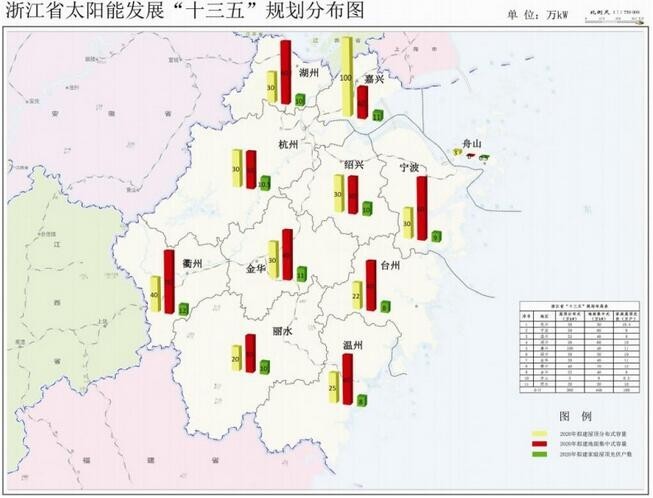
By 2020, the total installed capacity of photovoltaic power generation in the province will exceed 8 million kilowatts, including more than 3.6 million kilowatts of rooftop distributed photovoltaic power stations, more than 4.4 million kilowatts of ground-based centralized photovoltaic power stations, and more than 1 million households with household rooftop photovoltaic systems. In addition, by 2020, the total heat collection area of solar thermal utilization in the province will reach more than 20 million square meters.
III. Main Tasks
(I) Fully Promoting Rooftop Distributed Photovoltaic Power Generation
In areas with rooftop resources, convenient access, and on-site consumption conditions, we will fully promote the development and construction of rooftop photovoltaic power generation. We will focus on large industrial parks and economic and technological development zones across the province, where electricity consumption is concentrated, to build large-scale rooftop distributed photovoltaic power generation systems; accelerate the construction of rooftop photovoltaic power generation systems in public buildings such as shopping malls, schools, and hospitals; actively develop photovoltaic power generation systems integrated with new factory buildings and commercial buildings, gradually forming a diversified market for distributed photovoltaic utilization. By 2020, the construction scale of rooftop distributed photovoltaics in the province will reach more than 3.6 million kilowatts.
(II) Orderly Promotion of Ground-Based Centralized Photovoltaic Power Generation
We will make full use of barren hills and slopes, coastal tidal flats, land for facility agriculture, as well as fish ponds and water surfaces, adapting to local conditions and developing agricultural and fishery photovoltaic complementary centralized photovoltaic power stations in an orderly manner. In regions such as Quzhou, Jinhua, Lishui, and Shaoxing, which are rich in land for facility agriculture and hilly and mountainous areas, we will actively develop agricultural photovoltaic complementary power stations such as those integrated with agricultural greenhouses and agricultural planting. In regions such as Ningbo, Taizhou, Wenzhou, and Huzhou, which are rich in fish ponds and reservoirs, we will actively develop fishery photovoltaic complementary power stations. We will actively explore development models that organically combine ground-based photovoltaic power stations, floating photovoltaic power stations, and modern agricultural planting and fishery production, effectively giving full play to the comprehensive benefits of multi-energy complementary photovoltaic power stations.
By 2020, the construction scale of ground-based centralized photovoltaic power stations in the province will reach more than 4.4 million kilowatts.
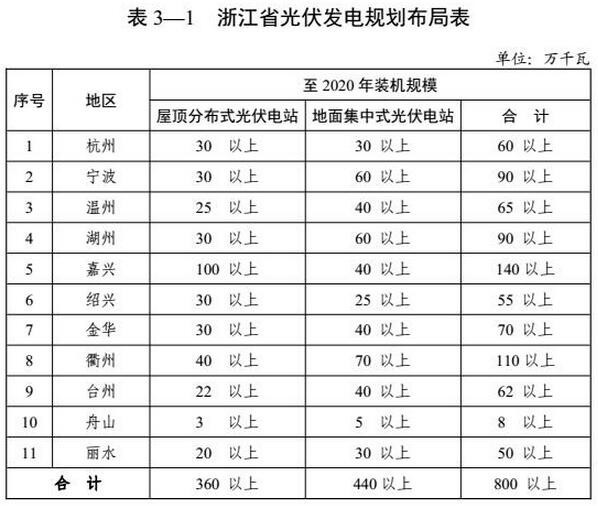
Note: The installed capacity of distributed and centralized photovoltaic power generation in various prefecture-level cities in 2020 is the minimum guaranteed scale.
(III) Comprehensive Implementation of Household Rooftop Photovoltaic Power Generation
Throughout the province, we will select various types of residential rooftops with suitable conditions, including independent rural houses, newly built civil buildings, concentrated housing in new rural areas, high-rise (multi-story) residential communities in cities, villas, and the homes of impoverished households, to comprehensively develop household rooftop photovoltaic applications. We will adhere to a market-driven approach, with the government providing guidance and support, encouraging state-owned capital, social capital, banks, and insurance companies to actively participate in the construction of household rooftop photovoltaics. At the same time, we will strictly control the quality and aesthetic coordination of household rooftop photovoltaic construction, and through providing design guidelines, layout examples, installation standards, and demonstration and promotion, we will make the construction of household rooftop photovoltaics a landscape of beautiful villages and a beautiful Zhejiang, effectively preventing the creation of new rooftop pollution.
We will carry out photovoltaic poverty alleviation work and implement the provincial photovoltaic poverty alleviation project. We will implement household rooftop photovoltaic projects for low-income households with an annual income of less than 4,600 yuan and key poverty-stricken villages under provincial pairing assistance, as identified in the survey at the end of 2014, enabling low-income households and key poverty-stricken villages to achieve long-term and stable income increases through household photovoltaic power generation, consolidating the achievements of "eliminating 4,600," and addressing the issue of weak collective economic income in key poverty-stricken villages.
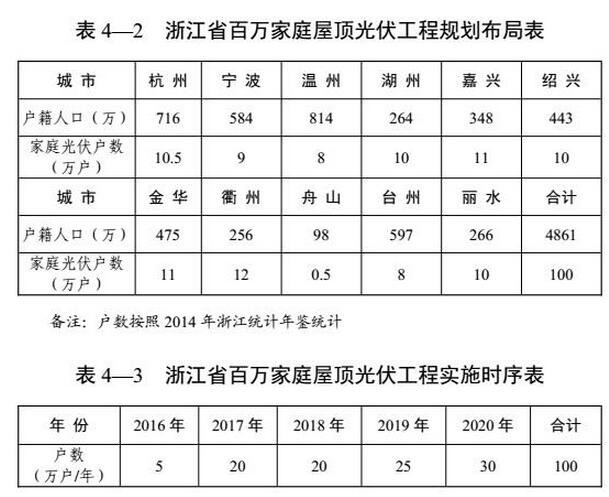
By 2020, the province will complete the construction of more than 1 million households with household rooftop photovoltaic systems, including more than 200,000 households under the photovoltaic poverty alleviation project, with a total installed capacity of approximately 3 million kilowatts, including approximately 1.2 million kilowatts under the photovoltaic poverty alleviation project.
(IV) Improving the Distribution Network Upgrade
We will accelerate the implementation of the provincial distribution network, especially the new round of rural grid upgrade project, focusing on strengthening investment in grid construction in regions with relatively small loads and multiple power sources, such as Quzhou, Lishui, Huzhou, and Dongtou, Wencheng, and Taishun in Wenzhou, Pan'an in Jinhua, and Sanmen in Taizhou. We will further improve the distribution network framework in rural areas and central towns, increase the voltage level of the distribution network, expand the substation capacity, and accelerate the construction of smart grids to ensure that photovoltaic power generation projects can be connected to the grid in a timely manner and that the power generation can be fully absorbed, supporting the independent choice of grid-connected modes for photovoltaic power generation (full grid connection or self-generation and self-use with surplus grid connection).
By 2020, the investment in distribution network construction in the province will exceed 700 billion yuan, including more than 400 billion yuan in rural grid construction investment, promoting a stronger urban and rural power grid and basically meeting the grid connection needs of ground-based photovoltaic power stations and one million household rooftop photovoltaic power generation in regions with relatively weak power grids such as Lishui and Quzhou.
(V) Steadily Promoting Solar Thermal Applications
We will further promote solar thermal utilization technology, mainly using rooftops of urban complexes, schools, hospitals, hotels, restaurants, public bathhouses, and large residential areas to install centralized solar water heating systems. We will strengthen publicity and guidance, implement financial subsidies, and combine urban residential communities and new rural construction to vigorously promote the use of solar water heaters in civil buildings. We will accelerate the exploration of innovative models for the integrated application of solar water heaters and photovoltaic power generation systems on building rooftops.
By 2020, the area of solar water heaters promoted and utilized in the province will reach 20 million square meters.
IV. Key Projects
(I) Distributed photovoltaic demonstration park project
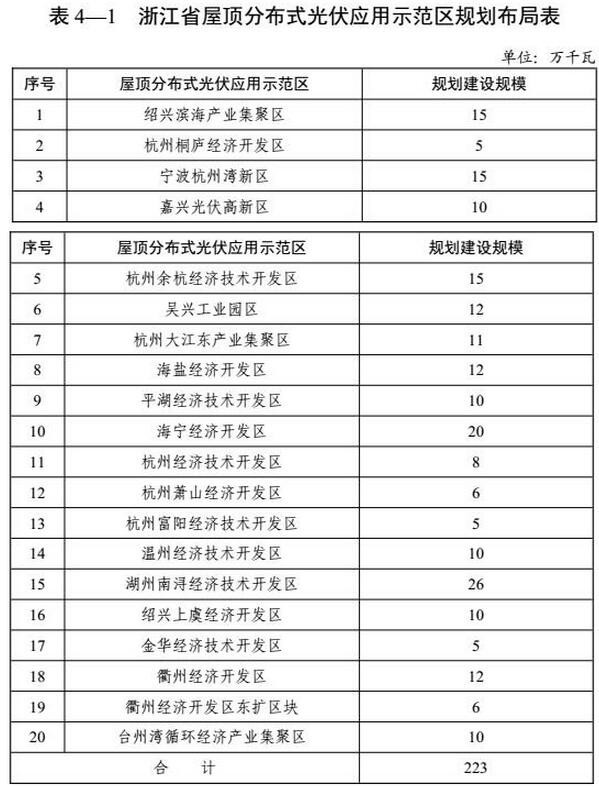
Accelerate the construction of national-level rooftop distributed photovoltaic demonstration areas such as Jiaxing Photovoltaic High-tech Zone, Hangzhou Tonglu Economic Development Zone, and Haining Economic Development Zone. At the same time, further explore concentrated contiguous areas such as economically developed industrial parks and economic and technological development zones within the province with high electricity loads
Factory rooftops of industrial and commercial enterprises to build provincial-level rooftop distributed photovoltaic power generation application demonstration areas. By 2020, the province will have built large-scale rooftop distributed photovoltaics with an installed capacity of more than 50,000 kilowatts.
(II) Large-scale ground-based photovoltaic power station base project
Utilize the tidal flats of coastal cities such as Ningbo, Taizhou, and Wenzhou to gradually build 100,000-kilowatt-level large-scale fishery-photovoltaic complementary ground-based photovoltaic power station bases; utilize barren hills and slopes, and facility agricultural land in cities such as Quzhou, Huzhou, Jinhua, and Lishui, to standardize the construction of agricultural-photovoltaic complementary ground-based photovoltaic power station bases, summarize the existing experience in the construction of agricultural-photovoltaic complementary photovoltaic power stations, accelerate the promotion of the organic combination of photovoltaics and modern agricultural planting technology, and form a 100,000-kilowatt-level large-scale agricultural-photovoltaic complementary ground-based photovoltaic power station base integrating green energy, high-efficiency agriculture, tourism, and science education. Utilize reservoirs and waterways to accelerate the exploration of floating and wire-suspended water photovoltaic power station technology, and demonstratively build a demonstration project of photovoltaic power generation combined with water ecological improvement.
By 2020, the province will have completed the construction of more than 3 large-scale 100,000-kilowatt fishery-photovoltaic complementary ground-based photovoltaic power station bases; more than 5 large-scale 100,000-kilowatt agricultural-photovoltaic complementary ground-based photovoltaic power station bases; and more than 3 water photovoltaic power generation demonstration projects.
(III) Million household rooftop photovoltaic project
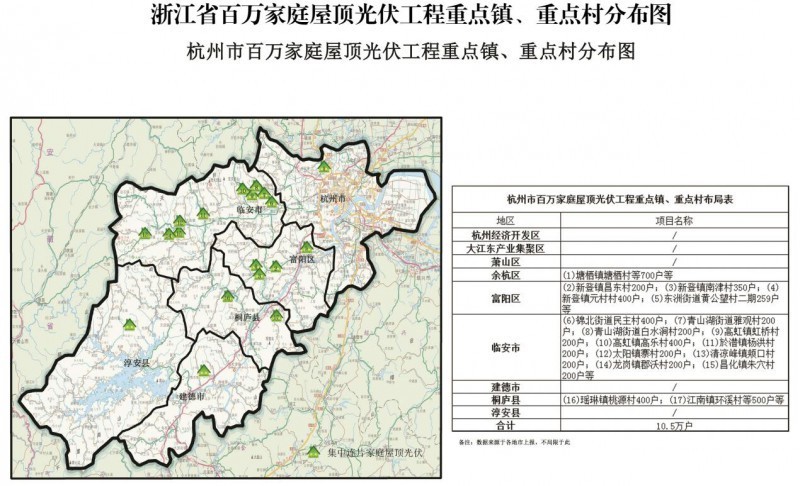
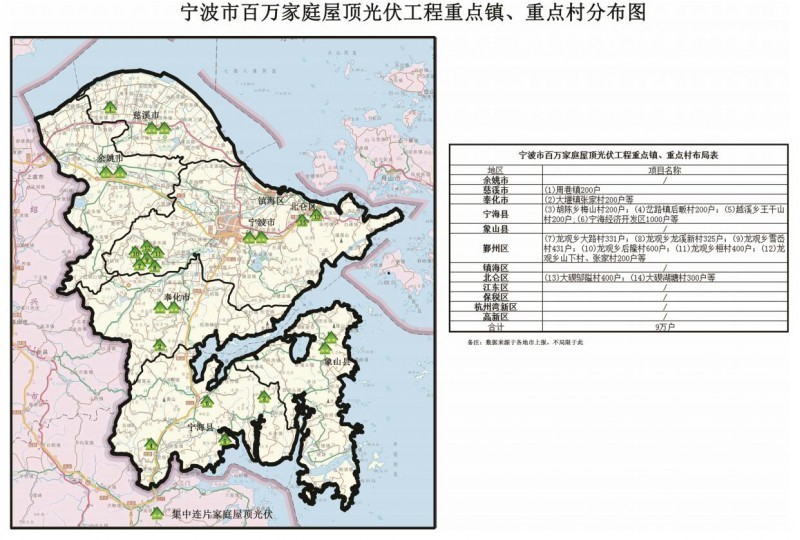
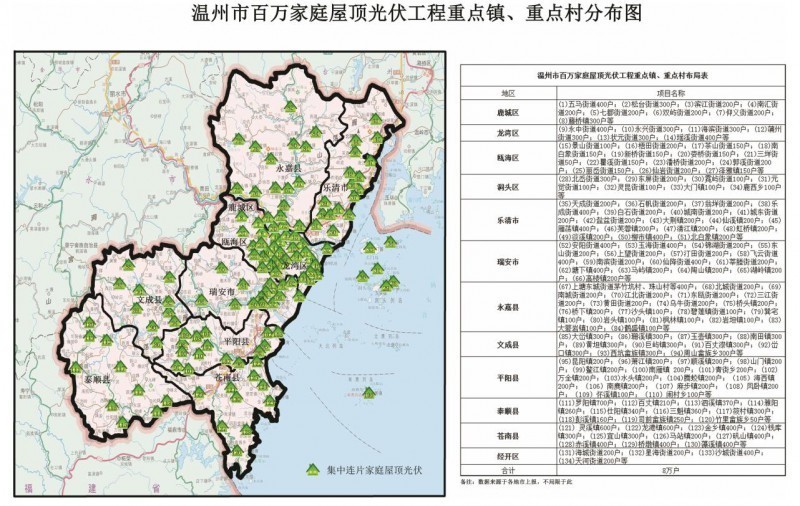
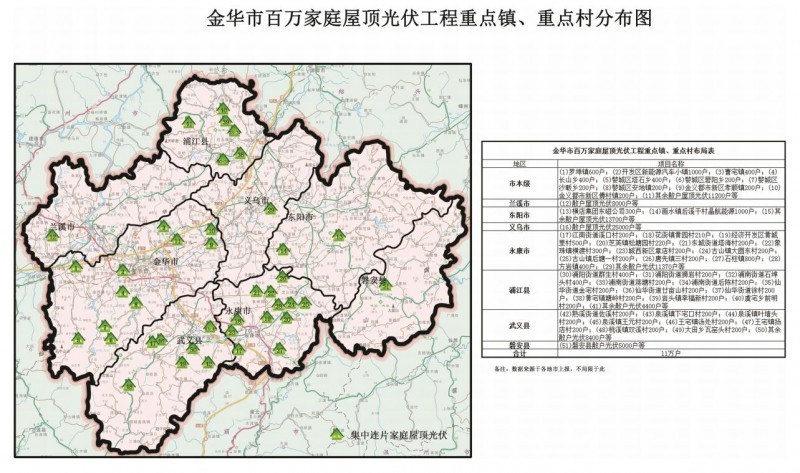
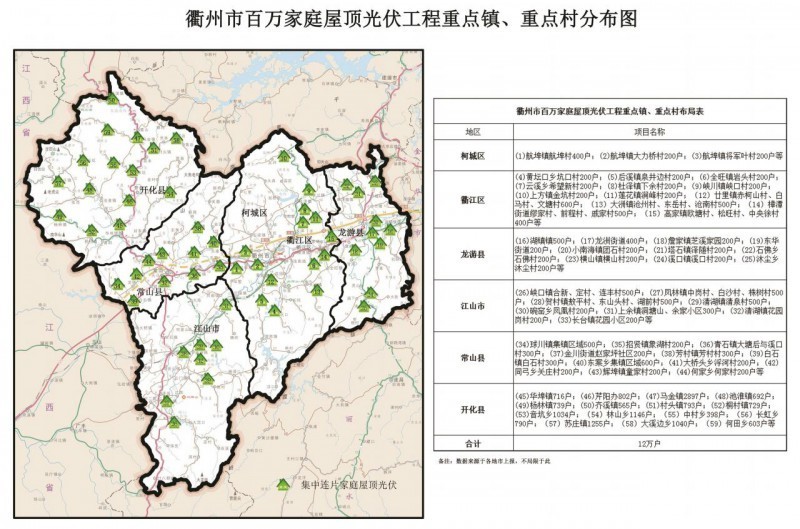
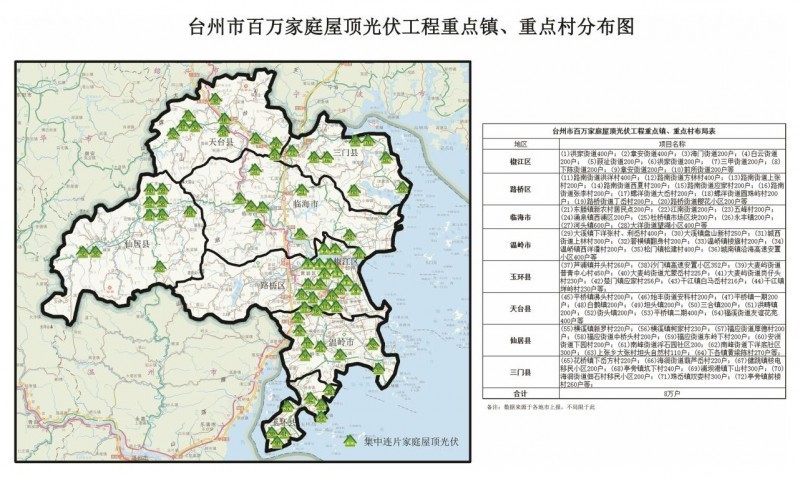
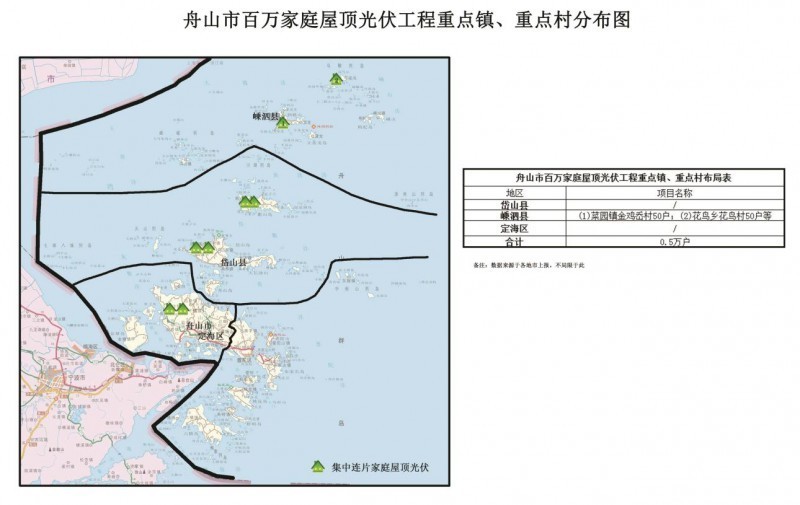
Utilize existing and newly built residential buildings in rural areas, urban concentrated residential communities, and the rooftops of homes of impoverished households to standardize and popularize the construction of the million household rooftop photovoltaic project. By 2020, the province will have completed the construction of more than 1 million household rooftop photovoltaics, with a total installed capacity of about 3 million kilowatts (planning layout see Table 4-2), mainly as follows:
——In conjunction with the construction of "Beautiful Countryside," by 2020, more than 400,000 household rooftop photovoltaics will be built in existing independent houses and newly built concentrated housing in rural areas across the province.
——In conjunction with the construction of photovoltaic building integration, by 2020, more than 200,000 household rooftop photovoltaics will be built in newly built urban and rural housing and newly built high (multi-) story residential communities in cities across the province.
——In conjunction with urban modernization construction, by 2020, more than 200,000 household rooftop photovoltaics will be built on existing building rooftops such as high (multi-) story residential communities and villas in urban and county main urban areas across the province.
——In conjunction with the construction of the photovoltaic Xiaokang project, by 2020, in Chun'an and 26 other counties that are accelerating development, and in Wucheng, Lanxi, and Huangyan, 3 districts/cities, the 180,000 low-income rural households with an annual income of less than 4,600 yuan and 2,100 provincial-level paired poverty alleviation key villages identified in the survey at the end of 2014 will carry out the photovoltaic Xiaokang project construction, building more than 200,000 household rooftop photovoltaics.
(IV) Advanced photovoltaic technology application project
Actively encourage the application of technologies such as the Internet, smart grids, and advanced energy storage in large buildings, industrial parks, islands, and towns of different scales, especially in newly built areas and energy expansion areas, and carry out demonstration projects of multi-energy complementation combining photovoltaics and other renewable energy sources with fossil energy such as natural gas, microgrid demonstration projects, and "Internet+" smart energy demonstration projects and other advanced technology application projects.
By 2020, the province will construct more than 10 demonstration projects including photovoltaic power generation, multi-energy complementation, "Internet+" smart energy, and microgrids.
(V) Photovoltaic power generation application demonstration area project
With the goal of promoting the sustainable development of towns and villages, combined with new urbanization and new rural construction, in accordance with the development concept of "new towns, new energy, new life," fully utilizing the renewable energy resources of towns and villages, accelerating the construction of national new energy demonstration cities (including Jiaxing Xiuzhou District China-Germany New Energy Demonstration City), as well as provincial clean energy demonstration counties, new energy demonstration towns, and household photovoltaic demonstration villages, and actively promoting the application of renewable energy technology, mainly photovoltaic power generation, in the power supply, construction, and transportation sectors of urban and rural areas.
By 2020, the province will have built 30 demonstration towns with more than 500 households of rooftop photovoltaic applications and 100 demonstration villages with more than 200 households of rooftop photovoltaic applications.
V. Supporting Measures
(I) Strengthen planning guidance and plan formulation
Give full play to the guiding role of the provincial solar energy development plan, and according to the construction indicators and key project layouts determined in the plan, various prefecture-level cities should expedite the formulation of local photovoltaic and other renewable energy development plans, and coordinate them with other local land, construction, water conservancy, forestry, and power grid plans. According to the overall planning goals and tasks, formulate annual plans for the province's ground-based photovoltaic power stations, million household rooftop photovoltaics, and other solar energy development. Prefecture-level cities should clarify their annual work priorities based on the mandatory indicators of the annual plan, and set deadlines for large-scale projects. Establish an integrated management mechanism for photovoltaic power generation planning, plans, and key projects, strengthen dynamic monitoring and evaluation of the implementation, and adjust them in a timely manner according to the prescribed procedures.
(II) Strengthen policy support and responsibility implementation
Encourage local governments to actively formulate support policies for the development of distributed rooftop photovoltaics, ground-based photovoltaic power stations, and household rooftop photovoltaics based on their actual conditions, and place the construction of photovoltaic and other renewable energy projects in a more prominent position. Local governments should effectively assume the main responsibility for promoting and coordinating the construction of photovoltaic power generation projects, actively coordinate and resolve key issues such as land and forest land that arise during photovoltaic development, and encourage the establishment of corresponding local promotion mechanisms by referring to the promotion and coordination mechanism for the construction of the provincial million household rooftop photovoltaic project, clarify departmental responsibilities, study and establish performance appraisal systems, strengthen supervision and inspection during the implementation process, form a joint effort to promote, and effectively promote the development of local solar energy applications.
(III) Strengthen standard construction and pilot demonstration
Strictly implement the relevant requirements of the "Technical Guide for the Application of Rooftop Solar Photovoltaic Power Generation Systems in Existing Civil Buildings" and the "Technical Guide for Integrated Application of Renewable Energy in Newly Built Rural Buildings," standardize the integrated application of solar photovoltaic and other renewable energy buildings, and coordinate solar energy utilization facilities and equipment with buildings and the surrounding environment. Explore the establishment of construction standards for agricultural-photovoltaic complementary and fishery-photovoltaic complementary photovoltaic power stations, standardize the construction of power stations, effectively achieve the effect of increasing agricultural and fishery efficiency, and ensure the high-quality and orderly construction of agricultural-photovoltaic complementary and fishery-photovoltaic complementary photovoltaic power stations. Construct clean energy demonstration counties, new energy demonstration towns, and photovoltaic power generation application demonstration areas to a high standard, and improve the standard requirements for the conversion rate of photovoltaic components, the installation effect of photovoltaic systems, and the implementation of multi-energy complementation in demonstration areas, so as to truly achieve the leading role of demonstration pilots.
(IV) Strengthen model innovation and work support
Encourage local areas to deepen their exploration of photovoltaic pension plans, photovoltaic loans, and other family rooftop photovoltaic promotion models, continuously summarizing and improving the market-oriented promotion of family rooftop photovoltaic construction, financing, and operation and maintenance.
Through the construction of microgrid demonstration projects, accumulate sustainable and replicable pilot demonstration experiences, promote the supply-side reform of distributed energy such as photovoltaic power generation, and explore business models such as regional direct transactions. Actively explore models such as large-scale industrial park rooftop photovoltaics, ground-mounted photovoltaic power stations supplying electricity directly, and photovoltaic power generation consumption and transactions within industrial parks. Local and relevant departments need to strengthen the management of special funds and subsidies for solar energy projects, implement tax support policies for photovoltaic projects, and support photovoltaic project owners in implementing project financing. The State Grid Corporation should effectively simplify the grid connection process for photovoltaic projects, provide good grid connection services for photovoltaic projects, accelerate the construction of distribution networks in weak grid areas such as Lishui and Quzhou, and effectively improve the efficiency of photovoltaic electricity price surcharge settlement. Local areas should increase publicity on the necessity, importance, and economic benefits of developing photovoltaic power generation and other renewable energy sources, creating a good atmosphere for promoting the application of photovoltaic power generation throughout society, and effectively mobilizing the enthusiasm of all parties.
VI. Investment Estimation and Social Impact Assessment
Developing and utilizing solar energy resources is an effective means of adjusting the energy structure and implementing sustainable energy development. After the project is completed, it can improve the regional power structure, alleviate the local electricity supply and demand contradiction, promote local economic development, increase employment opportunities, improve people's energy-saving awareness, and play a positive role in promoting the development of the solar energy industry in Zhejiang Province, with good economic and social benefits.
Based on the current situation of the photovoltaic equipment market, it is preliminarily estimated that the annual equivalent full-load utilization hours of photovoltaic power generation projects in Zhejiang Province are approximately 1000 hours. Referring to the investment cost of photovoltaic power generation projects already built in Zhejiang Province, the unit kilowatt static investment of rooftop distributed photovoltaic projects is about 7500 yuan/kilowatt, and that of centralized photovoltaic projects is about 6500 yuan/kilowatt.
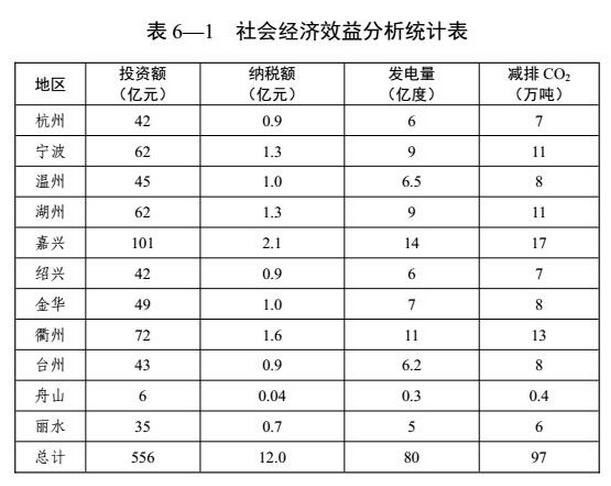
According to the planning goals of photovoltaic projects in Zhejiang Province, it is expected that by 2020, the total investment in photovoltaic projects
will reach around 55 billion yuan; after the project is completed, it will provide 80 billion
kilowatt-hours of clean electricity annually, reduce CO2 emissions by 970,000 tons, and increase annual tax revenue by about 1.2 billion yuan.
In addition, it will also drive the development of related industries such as power grid supporting construction and operation management in Zhejiang Province, providing a large number of job opportunities, with the most labor absorption in equipment manufacturing, engineering construction, and operation management. It is estimated that by 2020, photovoltaic power generation projects in Zhejiang Province will create more than 20,000 jobs.
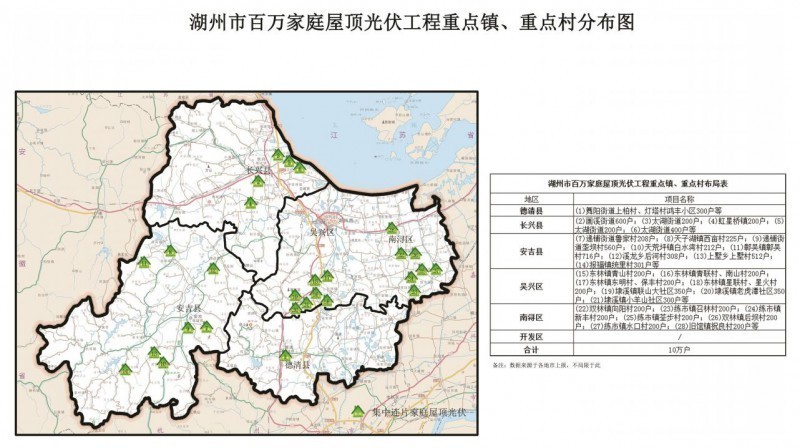
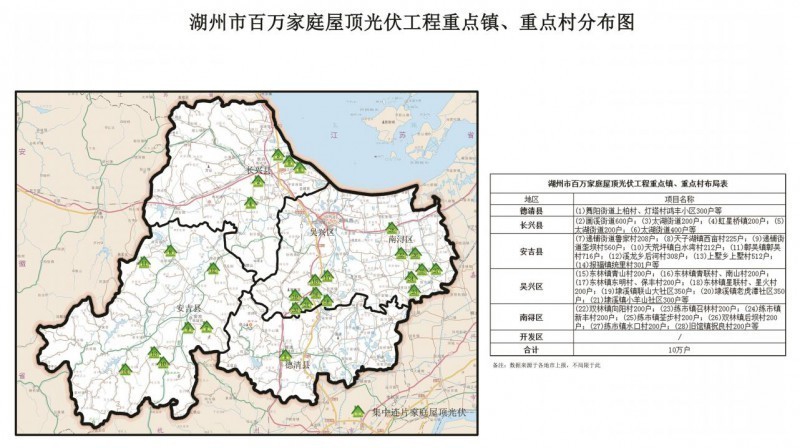
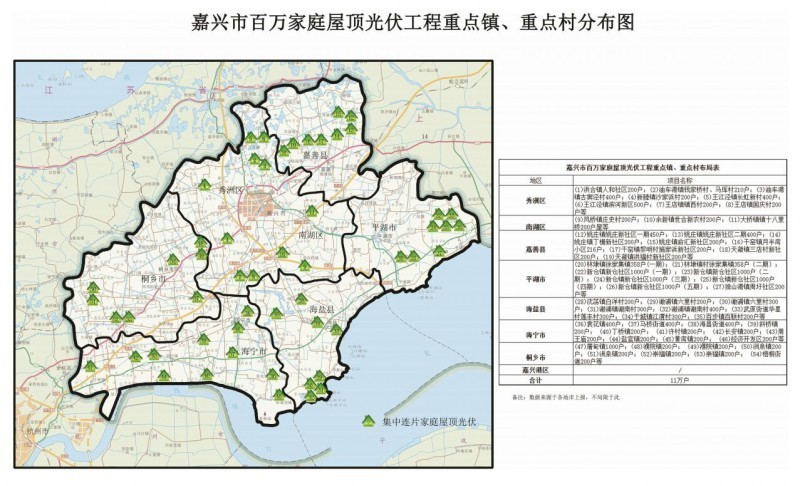
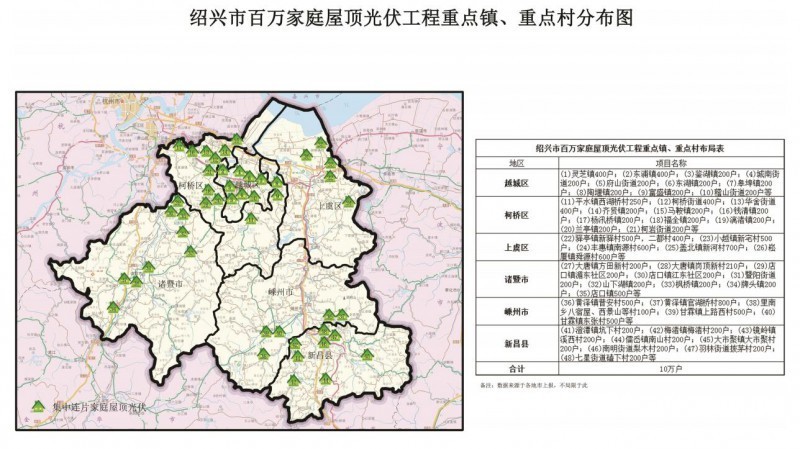
Attachment: 1. Distribution Map of Zhejiang Province's Solar Energy Development "13th Five-Year Plan"
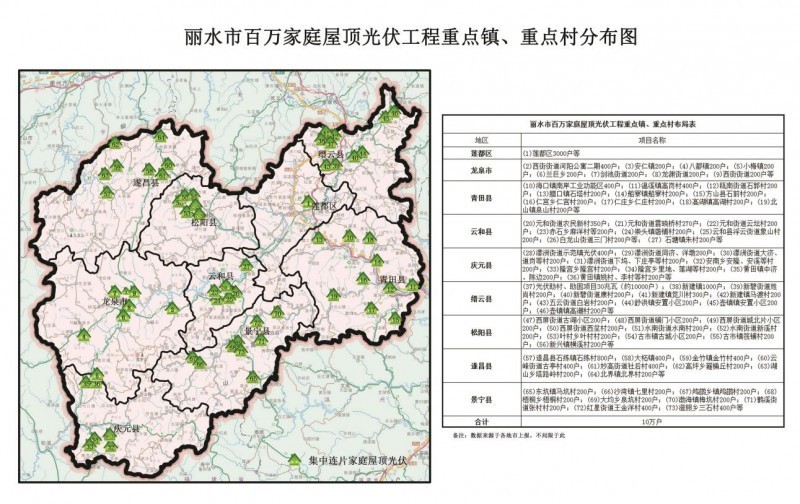
2. Distribution Map of Key Towns and Villages for Zhejiang Province's Million Family Rooftop Photovoltaic Project
Latest developments

lino power group
Service Hotline: +86-531-88729999
Address: No. 30766, Jingshidong Road, Jinan, China
Group Station Group:
Hongjitang
Linuo Pharma
Keyuan Pharma
Linuo Pharmaceutical Packaging
Linuo Ritter
Linuo Power
Wuhan Youji
Twin Tigers Coatings